ChatGPT now has more than 1.2 billion weekly users, and since 2026 businesses can advertise to them. On October 21, 2026, OpenAI expanded ChatGPT ads to 26 more countries, bringing the total to 89, and said more than 100,000 advertisers have already run campaigns. With a self-serve Ads Manager, a $25 minimum daily budget in the US, and ads that appear right below ChatGPT’s answers, this is a new channel small businesses can test today. This guide explains how ChatGPT ads work, where they are available, how to set up your first campaign step by step, what it costs, which rules apply, and whether it is worth trying.
Details in this guide come from OpenAI’s official announcements and Ads Manager help center as of October 26, 2026. Figures marked as third-party reports have not been confirmed by OpenAI. Advertising platforms change quickly, so check the help center before launching.
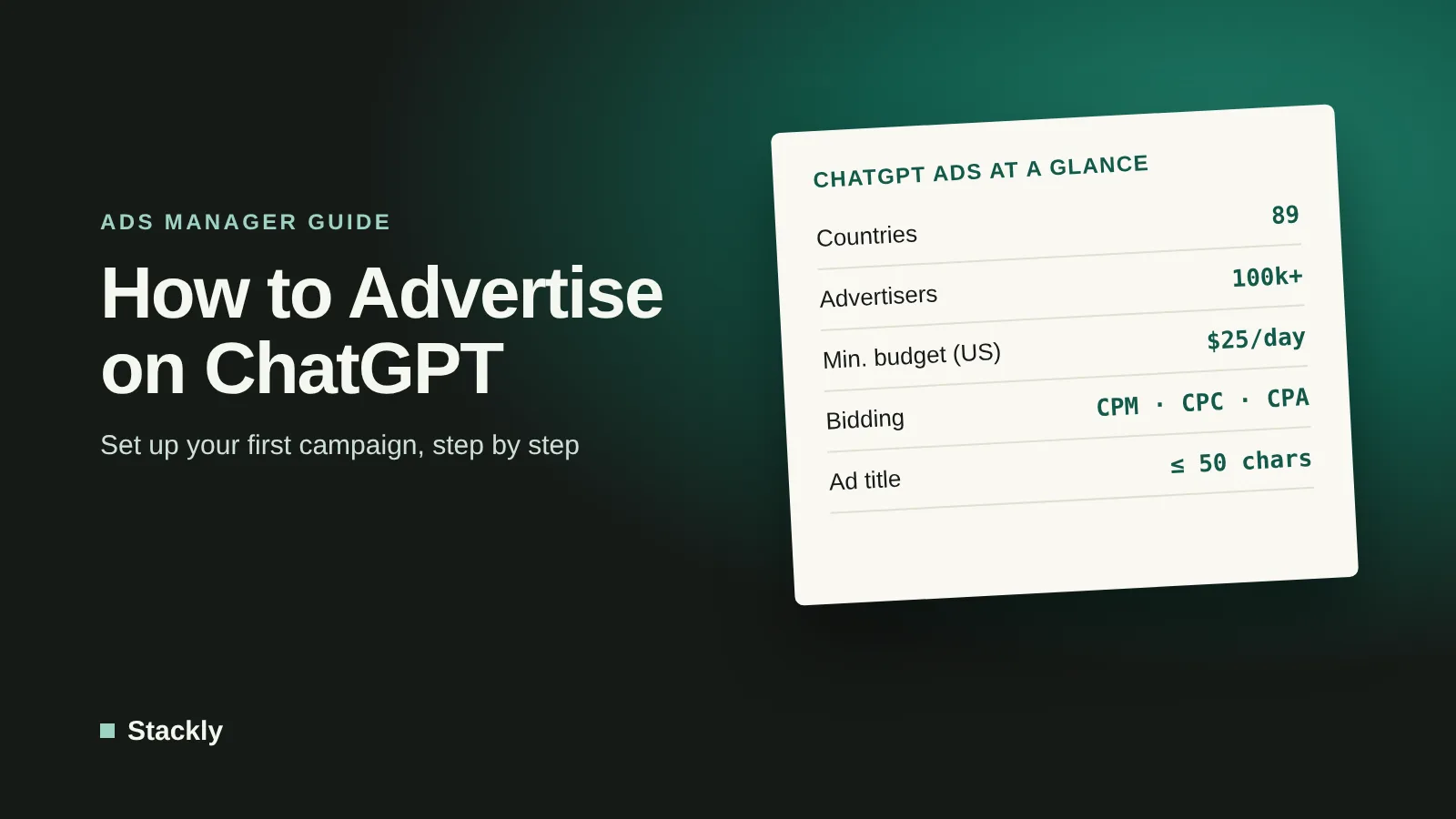
ChatGPT Ads at a Glance
Details
Where ads appear
Below ChatGPT’s answers, clearly labeled, for logged-in adults on the Free and Go plans
Plans without ads
Plus, Pro, Business, Enterprise, and Edu
Countries
89 for self-serve advertising, including the US, UK, Canada, Spain and most of the EU, India, Japan, and much of Latin America
How ads are matched
The topic of the conversation plus your “context hints”, not exact keywords
Bidding
CPM (impressions), CPC (clicks), or conversion-optimized
OpenAI first announced its approach to advertising in January 2026, with ads tested for logged-in adults in the US on the Free and Go plans (OpenAI). Since then, the program has expanded to Europe in August and to 89 countries in October.
An ad appears as a labeled “chat card” beneath ChatGPT’s answer when it is relevant to the conversation. For example, someone asking for help planning a kitchen renovation might see an ad from a local contractor or a home improvement store. OpenAI states that ads do not influence ChatGPT’s answers, advertisers do not see users’ conversations, and it does not sell user data.
How Ads Are Matched: Context Hints, Not Keywords
Unlike Google Ads, where you bid on specific keywords, ChatGPT matches ads using the topic and intent of the conversation, your ad and landing page, and context hints, short descriptions of the situations where your ad is relevant. If a user has ad personalization switched on, some signals from their wider ChatGPT use may also be used. You can add negative phrases to keep your ads away from topics you do not want (OpenAI Help Center).
Example context hints for a bookkeeping firm: “small business owner asking how to organize receipts”, “freelancer preparing for tax season”, “comparing bookkeeping software versus hiring an accountant”.
Where Are ChatGPT Ads Available?
According to OpenAI’s availability page, self-serve Ads Manager is available in 89 countries, including the United States, Canada, the United Kingdom, Switzerland, Spain and the other large EU countries, Turkey, India, Japan, South Korea, Australia, New Zealand, much of Latin America, the Middle East, and Southeast Asia, plus Kenya, Nigeria, and South Africa. The October expansion added markets such as Argentina, Chile, Colombia, Peru, Nigeria, South Africa, and Pakistan.
Your business must be based in a supported country to be billed. In the European Economic Area and Switzerland, ad personalization is not available, so ads there rely on conversation context only, and custom audience targeting cannot be used (OpenAI Help Center).
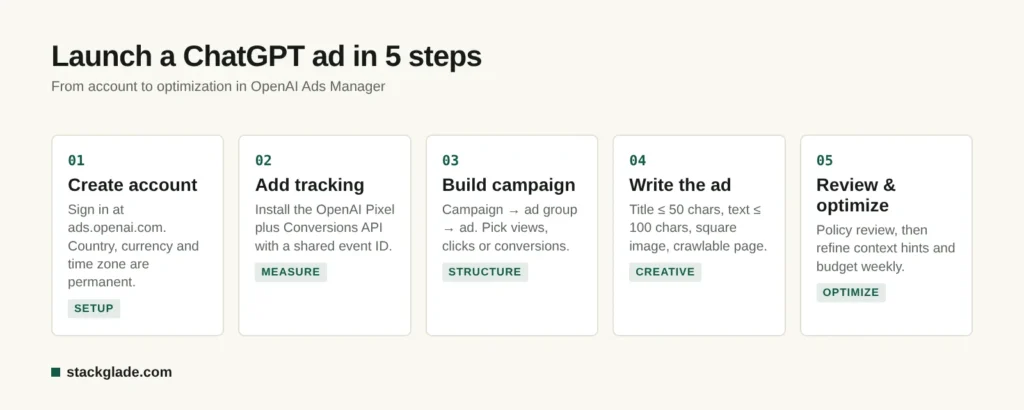
How to Advertise on ChatGPT: Step-by-Step
Step 1: Create Your Ads Manager Account
Go to ads.openai.com and sign in with your OpenAI account. You can enter your website address to have a first ad drafted automatically, or skip it. Then set your advertiser name, country, currency, and time zone. These three settings cannot be changed later, so choose carefully. Add a payment card and billing profile; campaigns do not run until billing is set up (OpenAI Help Center).
Step 2: Install Conversion Tracking
Before spending money, set up measurement. OpenAI offers two methods that work best together, connected by a shared event ID to avoid double counting (OpenAI Help Center):
OpenAI Pixel: a tag on your website that records conversions such as purchases or form submissions.
Conversions API: sends conversion events from your server, which is more reliable when browsers block tracking.
There are also integrations for Shopify and HubSpot and guides for Google Analytics 4.
Step 3: Create a Campaign
ChatGPT campaigns follow a familiar structure: Campaign → Ad group → Ad (OpenAI Help Center).
Campaign: choose an objective (views, clicks, or conversions), budget, dates, and countries.
Ad group: set a maximum bid or choose “Maximize results”, and write your context hints and negative phrases.
Ad: add your brand name, logo, title, text, landing page, and a square image.
Title: up to 50 characters (16 to 24 recommended).
Text: up to 100 characters (32 to 48 recommended).
Image: a square image; the help center mentions up to 1200 × 1200 pixels.
Landing page: must allow OpenAI’s crawlers to access it.
Write ads that answer the need behind the conversation, for example “Get your bookkeeping sorted in a week” rather than a generic slogan. Our guide to the best AI writing tools can help you draft variations.
Step 5: Launch, Review, and Optimize
Every ad goes through policy review before it runs. Once live, basic statistics such as impressions, clicks, and click-through rate refresh about every 15 minutes, while spend figures can lag several hours. After a week or two, pause weak ads, refine your context hints, and shift budget to the best performers.
ChatGPT Ad Formats
Standard chat cards: the default labeled ad below an answer.
Shopping ads (beta): created from a product feed, showing product images, names, ratings, prices, and sale prices. OpenAI says they are among its strongest performers but has not published figures (OpenAI Help Center).
Sponsored agents (closed alpha): users can chat with a business’s AI representative. OpenAI is not currently accepting requests to join.
How Much Do ChatGPT Ads Cost?
OpenAI supports three bidding models: CPM (cost per thousand impressions), CPC (cost per click), and conversion-optimized bidding, with either a fixed maximum bid or a “Maximize results” strategy. The minimum daily budget is $25 in the US; other markets vary. Daily spend can reach up to twice your daily budget on busy days, but weekly spend stays within seven times the daily budget (OpenAI Help Center).
OpenAI does not publish average prices. Industry newsletter PPC Land reported launch CPMs around $60, falling to about $25 by mid-April, and suggested starting CPC bids of $3 to $5 in the US. Treat these as rough third-party estimates.
A sensible test budget for a small business is $25 to $50 per day for two to three weeks, enough to see whether ChatGPT drives clicks and conversions at a cost you can accept compared with your other channels.
Targeting Options
Conversation context and context hints: the core of ChatGPT ads.
Countries: choose where your campaign runs.
Custom audiences: upload hashed email addresses or phone numbers to include customers (minimum 25,000 matched users), exclude them, or adjust bids from 0.1x to 10x. Not available for campaigns in the EEA or Switzerland.
Negative phrases: avoid irrelevant or unsuitable conversations.
OpenAI’s documentation does not mention age, gender, or interest targeting.
Ad Policies: What You Cannot Advertise
OpenAI’s ad policies are stricter than many platforms:
Prohibited: adult content and dating, alcohol above 0.5% ABV, tobacco and vaping, recreational drugs and cannabis, gambling and lotteries, political and issue ads, counterfeit goods, scams, graphic content, individual job and housing listings, unproven wellness claims, credit repair, debt settlement, and alternative investments such as bullion.
Restricted: financial, health, and legal services are allowed case by case for approved advertisers, mainly in the US, and generally banned elsewhere.
Sensitive conversations: ads do not appear near health, mental health, or emotionally reliant conversations, or reference topics such as religion, race, immigration, or gender identity.
Minors: no ads are shown to users who say they are, or are predicted to be, under 18.
ChatGPT Ads vs Google Ads and Meta Ads
ChatGPT Ads
Google Search Ads
Meta Ads
Targeting
Conversation context and hints
Keywords and search intent
Interests, demographics, behavior
Reach
1.2B+ weekly ChatGPT users, ads only on Free and Go
Billions of daily searches
Billions of Facebook and Instagram users
Maturity
New, fewer benchmarks
Very mature
Very mature
Best for
Considered purchases where people ask for advice
High-intent searches
Awareness and visual products
The honest assessment: ChatGPT ads are promising because people ask ChatGPT for recommendations at the exact moment they are making decisions, but the platform is young, published performance data is limited, and early prices were reported as high. Test it alongside your existing channels rather than moving your whole budget.
Is Advertising on ChatGPT Worth It for Small Businesses?
Worth testing if:
Your customers research before buying, such as software, professional services, home improvement, travel, or education.
You can write clear context hints about the problems you solve.
You have conversion tracking in place to measure results.
Probably not yet if:
Your category is restricted or banned, such as finance, health, or alcohol outside the US.
You can only afford a very small budget and cannot run a meaningful test.
You rely on precise demographic targeting.
Whatever you decide, the shift is a reminder that AI assistants are becoming a place where customers discover businesses. Making sure your website clearly explains what you do, with helpful content that AI tools can understand, matters as much as paid ads. Our guides to the best AI tools for small business, ChatGPT’s models and plans, and email marketing software can help you build the rest of your marketing stack.
Frequently Asked Questions
How do I advertise on ChatGPT?
Sign in to ads.openai.com with your OpenAI account, set up your advertiser profile and billing, install conversion tracking, then create a campaign with an objective, budget, context hints, and an ad with a title, text, image, and landing page. Ads are reviewed before they run.
How much does it cost to advertise on ChatGPT?
You can bid on impressions (CPM), clicks (CPC), or conversions. The minimum daily budget is $25 in the US. OpenAI does not publish average prices; third-party reports suggested CPMs of around $25 to $60 and starting CPC bids of $3 to $5 in the US earlier in 2026.
Which ChatGPT users see ads?
Only logged-in adults on the Free and Go plans. Plus, Pro, Business, Enterprise, and Edu users do not see ads, and no ads are shown to users under 18.
Are ChatGPT ads available in Spain and Europe?
Yes. OpenAI expanded ads to 31 European markets, including Spain, in August 2026. In the EEA and Switzerland, ad personalization is not available, so ads are matched by conversation context only and custom audiences cannot be used.
Can advertisers see my ChatGPT conversations?
No. According to OpenAI, advertisers do not see users’ conversations, OpenAI does not sell user data, and ads do not influence ChatGPT’s answers. Users can manage ad personalization in their settings.
The Bottom Line
ChatGPT ads give businesses a way to appear at the moment people ask an AI for advice, across 89 countries and more than a billion weekly users. The setup is simple, the minimum budget is modest, and the targeting is unlike any other platform. It is still early, with limited public benchmarks and strict policies, so start with a small, well-tracked test, write precise context hints, and compare results with your Google and Meta campaigns before scaling.
Leave a Reply