On October 21, 2026, Anthropic launched Claude Duet, a new app in which Claude works as a proactive, always-on agent. Instead of waiting for you to ask, Duet reviews your email and calendar every morning, checks your connected apps every few hours, and messages you when something needs attention, from an unpaid invoice to a scheduling conflict. Anthropic says it is built for “professionals and small business owners with more on their plates than they can track”. This guide explains what Claude Duet is, what it can do, who can use it, how much it costs, how its safety and privacy protections work, and how it compares with ChatGPT dots and Claude Cowork.
Claude Duet is a research preview. This guide reflects Anthropic’s announcement, help center, and safety documentation, plus early reviews, as of October 26, 2026. Features and availability are likely to change.
Claude Duet at a Glance
Details
Launched
October 21, 2026 (research preview)
What it is
A proactive personal agent in its own app
Model
Claude Opus 5.5
Platforms
iOS and Android apps; web access mentioned in the announcement
Availability
US only, Pro and Max plans, via waitlist
Extra cost
None; uses your normal Pro or Max usage limits
Connected apps
More than 6,000 connectors and plugins, including Gmail, Slack, QuickBooks, Stripe, Shopify, and HubSpot
Approvals
Always asks before sending, paying, signing, or deleting
Claude Duet is a standalone app where you message Claude “the way you’d message a person”, by text or voice, and it works on your behalf in the background. It brings along your existing Claude memory, skills, and connected apps, and can search your past Claude conversations for context.
Unlike a normal chat, Duet runs on its own cloud computer with its own browser, so it keeps working even when your phone or laptop is off. The app is organized around one main conversation, separate topic threads that share memory, a tab for bigger outputs such as research briefs, financial models, slide decks, and dashboards, and a Tasks tab that tracks ongoing work, where only you can mark a task as done (9to5Mac).
What Can Claude Duet Do?
Morning Brief
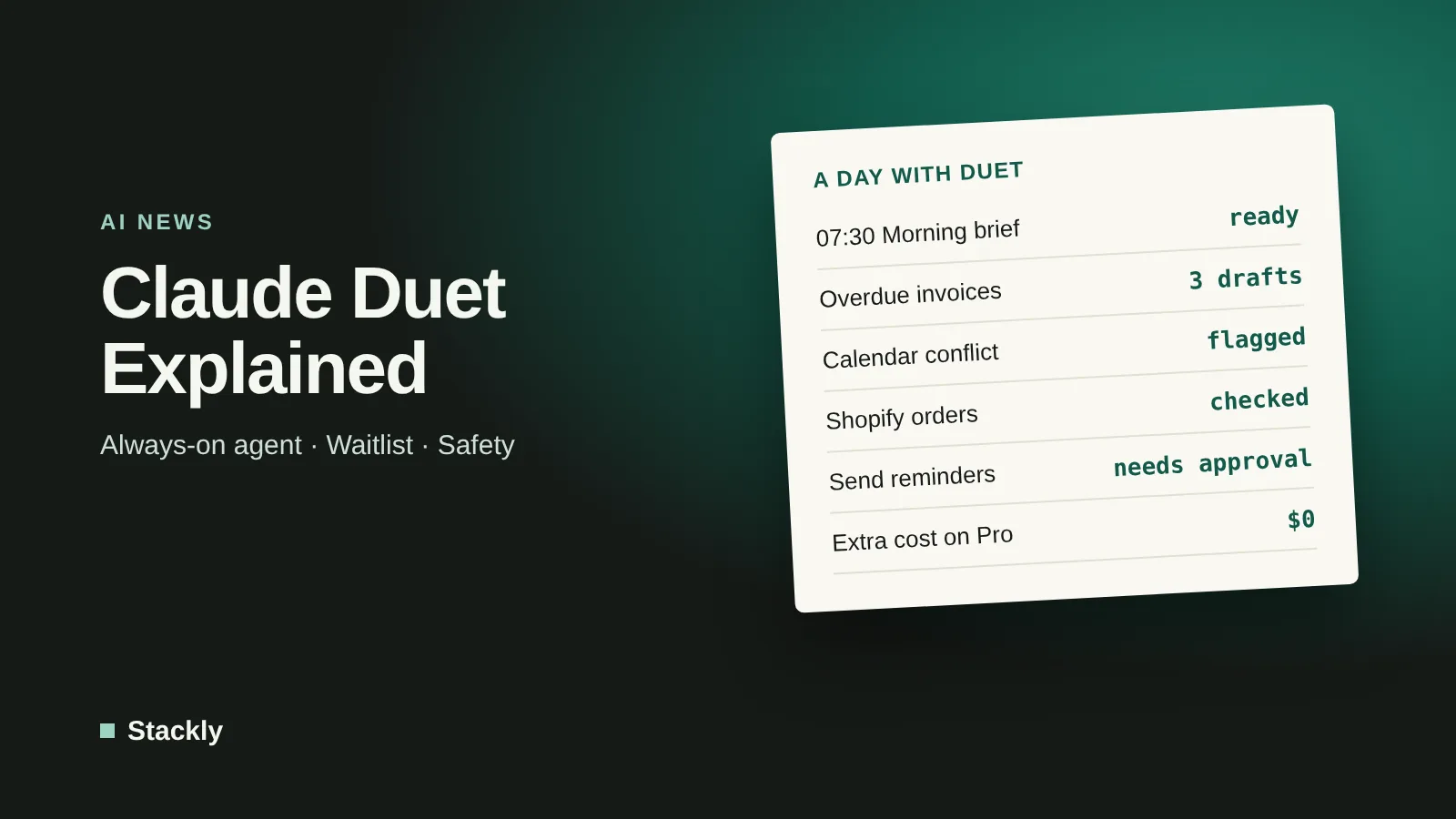
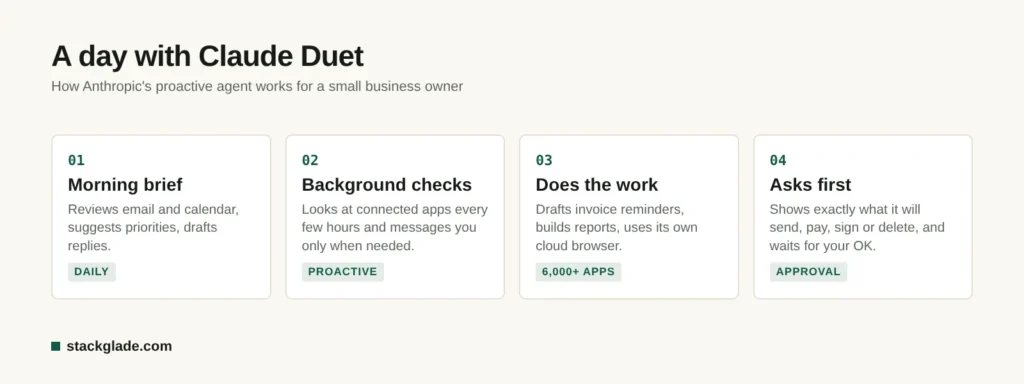
Each day, Duet reviews your email and calendar, suggests priorities, and drafts replies for you to review.
Background Monitoring
Duet checks your connected accounts every few hours and messages you only when something needs attention. Anthropic says checks are not continuous because constant monitoring would use up plan limits faster.
Proactive Suggestions
Duet flags problems without being asked. In Anthropic’s example, it spotted a property booking that appeared on the wrong day in a tester’s calendar. You can choose what it tells you about and how often.
Real Work Across Your Apps
Duet can use more than 6,000 connectors and plugins from Claude’s marketplace. Anthropic names Gmail, Slack, QuickBooks, Stripe, Gusto, LinkedIn, Docusign, HubSpot, Canva, and Shopify, and the help center adds Google Calendar, Google Drive, and Calendly. For example, with Stripe connected, Duet can check unpaid invoices and draft payment reminders. For websites without a connector, it uses its own cloud browser.
Purchases, With Guardrails
Duet can make purchases through Stripe’s Link wallet, using a one-time virtual card, or through Shop Pay, both connected inside Duet. Every payment requires your explicit approval.
Small Business Use Cases
Duet is clearly aimed at small business owners. Practical examples include:
Cash flow: spot overdue invoices in Stripe or QuickBooks and draft polite reminders. Our accounting software guide covers the tools it connects to.
Inbox triage: a morning summary of what needs a reply, with drafts ready to approve.
Scheduling: catch double bookings and calendar conflicts before they cause problems.
Sales follow-up: remind you about leads in HubSpot that have gone quiet and draft follow-ups. See our small business CRM guide.
Online store: watch Shopify orders and flag issues, with a visual storefront editor promised soon.
Reports: build a weekly summary or dashboard from your connected data.
Who Can Use Claude Duet, and What Does It Cost?
At launch, Duet is limited to:
The United States only, with a US Claude account.
Pro and Max subscribers. Team and Enterprise support is planned but not yet available.
A waitlist. Invitations are sent by email in waves, and joining the waitlist does not guarantee a date.
Duet costs nothing extra on Pro or Max. It shares the same five-hour session and weekly usage limits as regular Claude chat, and background work such as the morning brief and account checks counts against those limits. As a launch bonus, people admitted to the preview get one full reset of their session and weekly limits, usable until November 30, 2026, according to the help center. Claude Pro costs $20 per month, and Max starts at $100 per month; our Claude guide compares the plans.
How to Join the Claude Duet Waitlist
According to Anthropic’s help center:
Open the Claude Duet page and choose the waitlist option.
Enter your name and email, ideally the same email as your Claude account.
Select your plan and phone type (iPhone or Android), and optionally describe your work and a first task.
Wait for the invitation email and open it on your phone.
Install the app using the Apple or Google account tied to the same email; a mismatch can block access.
Sign in with your Claude account. Activation can take a few minutes, and your memory, skills, and connected apps carry over automatically.
Safety: What Duet Can and Cannot Do
Because Duet can act in your accounts, Anthropic built several layers of protection, described in its safety, privacy, and security post:
Approval before important actions. Before Duet sends a message, pays, signs a document, or deletes anything, it shows exactly what it plans to do, including every recipient, and waits for your OK. If you are not available, it completes the rest of the task and returns for approval.
No “don’t ask again” for the riskiest actions. Paying or sending money, deleting an order, and creating an account always require approval, even in routines that run while you are away.
Blocked actions. Trading securities, moving money between accounts, and accessing another person’s account are blocked even if you approve.
Independent checks. A separate system outside the model reviews each action against what you asked for, and another scans outgoing messages and uploads.
Sensitive data protection. Duet will never share sign-in credentials, full card or bank numbers, or government ID numbers, “even if you ask”.
No phone calls or texts. It can send emails with your approval but cannot call or text.
Anthropic is candid that safeguards “will occasionally miss something or flag a harmless message”, and that the risk of prompt injection, where malicious instructions hidden in emails or web pages try to manipulate an AI, is reduced but not eliminated. Our guide to setting up AI agents explains how to limit permissions safely.
Privacy: How Duet Handles Your Data
Passwords stay hidden from the AI. Anthropic says Duet “never sees your passwords, browser cookies, sign-in tokens”. You enter passwords in a secure form in the Claude app, and a system outside the agent inserts them.
Watch for phishing. A genuine password request only appears during a sign-in you started in the Claude app or on claude.ai, as Help Net Security highlights.
Retention. Chats and memory are kept until you delete or reset them; disconnecting an app stops new access but keeps what Duet already learned; deleting your account erases everything.
Transparent browsing. Duet identifies itself to websites and publishes its browsing IP addresses, so some sites may block it.
Anthropic’s safety post does not say whether Duet data is used for model training, so check your Claude privacy settings. For extra account protection, use a business password manager and multi-factor authentication.
Known Limitations
Anthropic and early reviewers list several limitations:
It may misread a thread or misjudge what is urgent.
Because checks run every few hours, urgent items can arrive late.
It is weaker at personal errands such as booking tickets.
You cannot watch or take over its browser, or choose the model.
Microsoft 365 is not supported yet, and Slack support is partial.
Reviewers at Every noted that scheduled runs cannot reach custom connectors and that voice input is transcription only.
Claude Duet vs ChatGPT Dots vs Claude Cowork
Claude Duet
ChatGPT dots
Claude Cowork
Launched
October 21, 2026
September 29, 2026
Earlier in 2026
Style
Proactive: watches your apps and messages you
Always-on agent working toward goals
Task agent you direct
Model
Claude Opus 5.5
GPT-6 Astra (per OpenAI)
Your choice of Claude models
Own cloud computer
Yes, but you cannot watch its browser
Yes, and you can open it to watch
Cloud or your desktop
Connected apps
6,000+
4,000+
Claude connectors
Plans at launch
US Pro and Max (waitlist)
Pro and Business Premium (Pro excludes EEA, Switzerland, UK)
Pro, Max, Team, Enterprise
Approvals
Fixed for sensitive actions
Custom Rules per action
Manual, Auto, or skip modes
In short, Duet is the most “assistant-like” of the three, proactively watching your business and asking for approval; ChatGPT dots offer more visibility into what the agent is doing and broader channels such as Slack and Teams; and Cowork is best when you want to direct a specific task yourself. Read our guide to ChatGPT dots for a closer look at OpenAI’s alternative, and our overview of AI agents for small business for other options.
Early Reviews
Dan Shipper of Every called Duet “the first personal agent I’d call a pro tool” and advised Claude subscribers who do knowledge work to join the waitlist, while noting that its email drafts trailed ChatGPT dots in his testing. Coverage from TechCrunch framed the app as Anthropic’s bet on agents, competing with OpenAI’s dots and Meta’s Muse.
Frequently Asked Questions
What is Claude Duet?
Claude Duet is Anthropic’s proactive AI agent app, launched as a research preview on October 21, 2026. It runs on Claude Opus 5.5, reviews your email and calendar daily, checks your connected apps every few hours, and messages you when something needs attention, asking for approval before taking important actions.
Is Claude Duet free?
It costs nothing extra for Claude Pro and Max subscribers, but it uses the same usage limits as regular Claude chat. It is not available on the Free plan.
Is Claude Duet available outside the US?
Not yet. At launch, Duet is limited to US Claude Pro and Max subscribers through a waitlist. Anthropic has not announced other countries.
Can Claude Duet make payments?
Yes, through Stripe’s Link wallet with a one-time virtual card or through Shop Pay, but every payment requires your explicit approval, and actions such as moving money between accounts or trading securities are blocked.
How is Claude Duet different from ChatGPT dots?
Both are always-on agents with their own cloud computers. Duet focuses on proactively monitoring your apps and messaging you, with fixed approvals for sensitive actions. Dots let you watch the agent’s computer and work in Slack and Teams, and are available on ChatGPT Pro and Business Premium.
The Bottom Line
Claude Duet is Anthropic’s most ambitious step toward an AI assistant that works like a capable team member: it watches your inbox, calendar, and business apps, flags what matters, and does the busywork once you approve. It is early, US-only, and limited by usage caps, but for small business owners already paying for Claude Pro or Max, it is worth joining the waitlist. Start with low-risk tasks such as morning briefs and invoice reminders, and keep approvals in place for anything important.
Leave a Reply