Every few months a new forecast promises that AI will transform everything by 2030. Most of those predictions are written for the boards of large corporations, not for a ten-person agency, a local service company, or a freelancer. This guide takes the best-documented forecasts from Gartner, PwC, and other sources, filters them through a small business lens, and explains what is likely to change between now and 2030, what remains uncertain, and what you can do today so that the next wave does not catch you off guard. For a snapshot of where the technology stands right now, start with our overview of the state of AI in 2026.
Forecasts in this guide reflect published research as of early October 2026. Predictions are opinions, not facts, and they change quickly, so treat them as scenarios to plan around rather than certainties.
Why Forecasts Need a Reality Check First
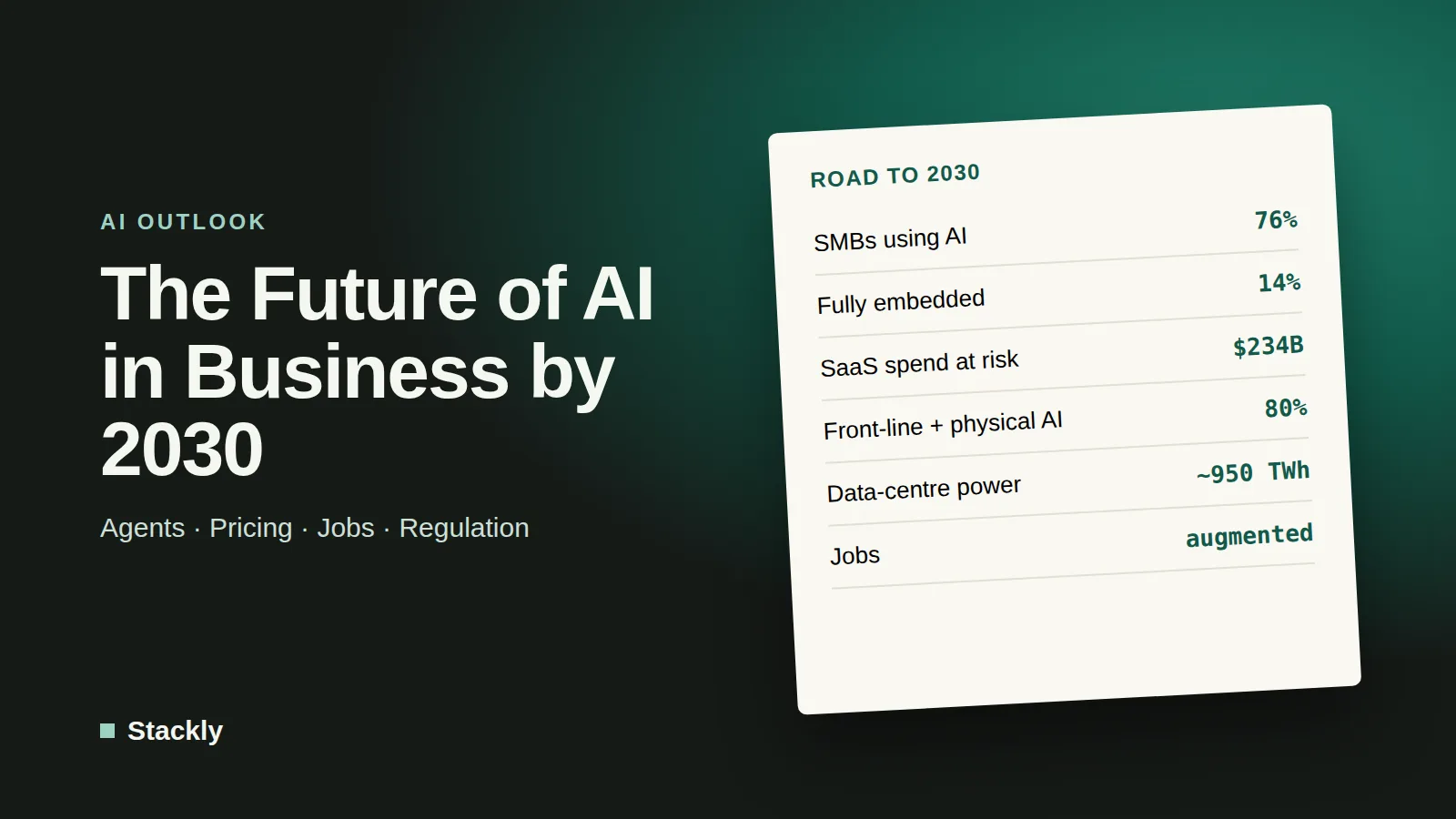
Before looking ahead, it helps to be honest about the present. AI use among small businesses is high, but depth of use is low. In a survey published in March 2026 by Goldman Sachs 10,000 Small Businesses Voices, 76% of small business owners said they currently use AI, and 93% of those users reported a positive impact. Yet only 14% said AI was fully embedded in their core operations.
The picture is similar at the top of the market. PwC’s 29th Global CEO Survey, which covered 4,454 chief executives in 95 countries, found that 56% had seen neither higher revenue nor lower costs from AI over the previous 12 months. Only 30% reported increased revenue, 26% reported lower costs, and just 12% achieved both.
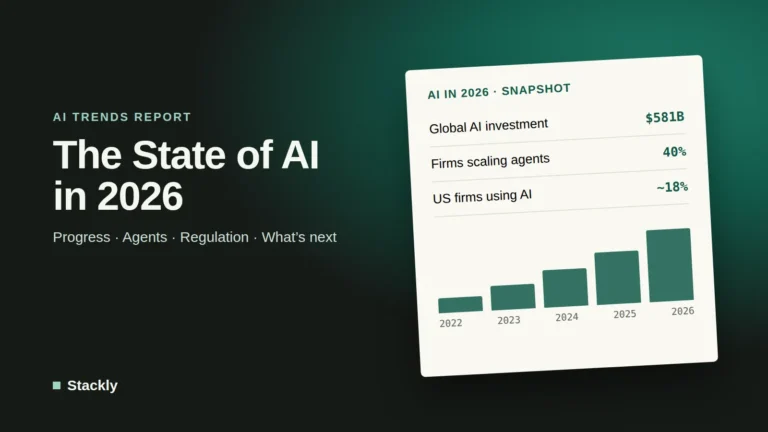
Survey numbers also vary widely depending on how the question is asked. The US Census Bureau, which asks specifically whether a business uses AI to produce goods or services, reported that roughly 17% to 20% of US businesses did so between December 2025 and May 2026. Surveys that count any AI feature inside an email app or accounting tool produce much higher figures. Both can be true at the same time: almost everyone has tried AI, but few businesses have rebuilt a process around it.
This gap between trying and transforming is the key to reading every forecast below. The next five years will reward businesses that close it.
Trend 1: From Tools You Open to Agents That Work for You
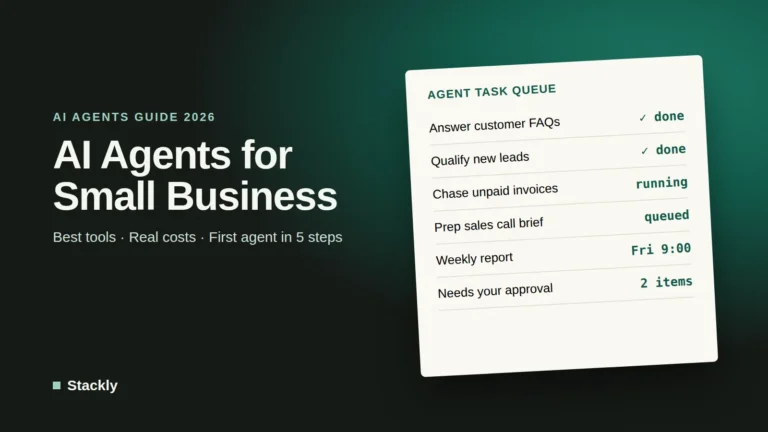
The most consequential shift is the move from AI that answers questions to AI agents that complete tasks across several systems. Instead of opening a CRM, a spreadsheet, and an email client yourself, you describe an outcome and an agent works through the steps. We explain how this works in practice in our guide to AI agents for small business.
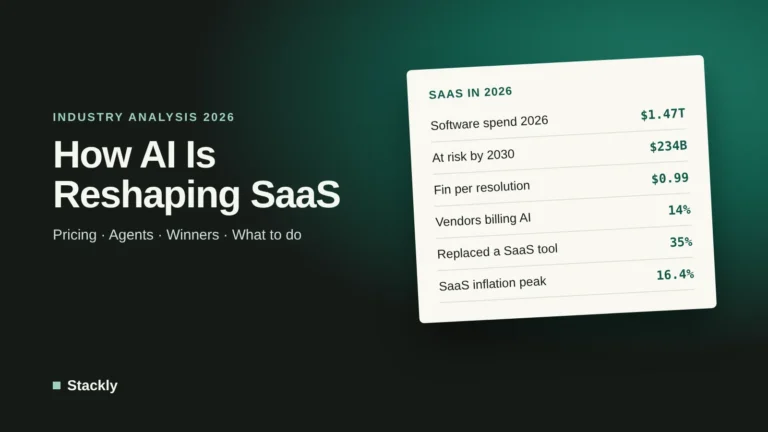
Gartner put a number on how disruptive this could be. In a July 2026 forecast, the firm said that up to $234 billion of enterprise application software spending is exposed to what it calls “agentic arbitrage” between now and 2030, roughly 20% of enterprise software-as-a-service spending by 2030. Agentic arbitrage happens when agents complete tasks across multiple systems, so people no longer need to open each application themselves. Gartner analyst George Brocklehurst described the result as less an apocalypse and more of a metamorphosis, meaning software will not disappear but will change form.
For a small business, the practical meaning is simple. The tools you pay for today will increasingly include agents, and the way you judge them will shift from “how many features does it have?” to “what result does it deliver?”
A caution applies. Not every product labeled “agent” earns the name, and Gartner has previously predicted that more than 40% of agentic AI projects will be canceled by the end of 2027 because of rising costs, unclear value, or weak risk controls. Expect real progress and real disappointment in the same period.
Trend 2: Software Pricing Moves From Seats to Results
If agents do more of the work, fewer people need to log in, and that breaks the way most software is sold. Gartner’s analysis points out that agentic systems weaken the link between the number of users and vendor revenue, which pushes vendors toward pricing based on usage or outcomes instead of per-seat licenses.
What this means for you in the coming years:
Expect pricing changes at renewal. Per-user plans may be replaced by usage-based or outcome-based models. Read renewal notices carefully rather than accepting them automatically.
Review your software stack every year. Tools that overlap with AI features already included in your main platforms may no longer be worth paying for.
Keep your data portable. The more your business data lives in one vendor’s system, the harder it is to switch if pricing or quality changes. Our guides to the small business CRM market and website platform lock-in show how to think about this.
Small businesses will rarely buy a robot fleet. Physical AI is far more likely to reach them through the suppliers, delivery partners, and software they already work with: smarter inventory forecasting, automated warehouse picking at your logistics provider, or route planning built into your delivery app. The practical advice is to ask your key suppliers what they are automating, because it will change lead times, pricing, and reliability.
Trend 4: Governance, Insurance, and Trust Become Competitive Issues
As AI takes on more responsibility, someone has to make sure it behaves. Three developments are worth watching.
Insurers. Gartner research, as summarized by IoT Business News, expects insurers to become an important force in AI governance by 2030, because liability coverage will push companies toward stronger technical controls. In practice, businesses may eventually be asked how they use AI when they apply for or renew coverage.
Regulation. The European Union’s AI Act is phasing in obligations over several years. A 2026 package of amendments postponed the strictest high-risk requirements to December 2027 and August 2028, while transparency duties such as telling people when they are interacting with AI are being introduced from 2026. In the United States, the Federal Trade Commission applies existing consumer protection law and has published business guidance on AI claims.
The takeaway: being transparent and careful with AI is turning from a nice-to-have into a trust signal that customers, partners, and insurers will notice.
Trend 5: Jobs Change Before They Disappear
The most common fear is that AI will eliminate jobs. The current evidence from small businesses points in a more moderate direction. In the Goldman Sachs survey, 87% of owners said AI augments rather than replaces employees, and 67% expect AI to increase their revenue. The Homebase 2026 Main Street AI Gap Report, based on 750 US small business decision-makers, found they were more than twice as likely to expect AI to help their business grow (49%) as to reduce headcount (22%).
That does not mean work stays the same. The likely pattern through 2030 is a shift in tasks: less first-draft writing, data entry, scheduling, and searching, and more reviewing, deciding, customer relationships, and problem-solving. Skills are the real bottleneck. In the Goldman survey, 73% of small businesses said additional training and implementation resources would help them.
The businesses best positioned for 2030 are not those with the most advanced tools but those whose people know how to direct AI, check its output, and decide when not to use it.
Trend 6: Costs and Energy Shape the Pace
AI will not scale without electricity and computing power. The International Energy Agency estimates that data centers used about 485 terawatt-hours of electricity in 2025, around 2% of global demand, and projects roughly 950 TWh by 2030. Even if the cost of using AI for a given level of quality keeps falling, the most advanced systems will stay expensive to run, and that will influence pricing and usage limits on the tools you rely on.
For a small business, the sensible response is to track AI spending as its own line item, check which plan or model tier you actually need, and avoid paying for the most powerful option when a cheaper one does the job. Our guides to ChatGPT models and plans and Claude models and plans explain how to match model to task.
What Is Still Uncertain
Honest forecasting includes admitting what nobody knows. Several questions remain open:
How fast agents become reliable. Today’s agents handle well-defined tasks, but long, ambiguous projects still need supervision.
Whether returns will broaden. If only a minority of companies capture measurable value, as the PwC data suggests, the gap between leaders and laggards could widen.
How regulation evolves. Rules are still being written and postponed, and they differ between regions.
Timelines for human-level AI. Some predictions claim AI will match human experts across most tasks within a few years. There is no consensus, and planning around what tools can reliably do today is safer.
How to Prepare: A Practical Checklist
You do not need to predict the future perfectly to prepare for it. These steps are useful under almost any scenario:
Build the habit now. Pick one repetitive task and use AI on it every week. Experience compounds faster than any forecast.
Write down your processes. Agents need clear steps, rules, and examples. Businesses with documented workflows will automate faster.
Keep your data clean and portable. Organized customer records, consistent naming, and exportable files make every future tool work better.
Create a one-page AI policy. Define what data staff may and may not paste into AI tools and which outputs need human review. Our website security checklist is a good companion.
Invest in training. Even a few hours a month on prompting and verification pays off.
Measure results. Track time saved or revenue gained, and drop tools that do not pay for themselves.
Watch your vendors. Ask your key software and supply partners how they are using AI and how it will affect pricing and service.
Most forecasts expect AI to function as invisible infrastructure: embedded in the software you already use, handling multi-step tasks as agents, and increasingly connected to physical systems such as robots and logistics. Gartner, for example, expects the majority of front-line workers at international companies to be assisted by physical AI by 2030. Timelines remain uncertain, so it is wise to plan for gradual change.
Will AI replace small business jobs?
Current surveys suggest AI is mostly changing tasks rather than eliminating roles. In the Goldman Sachs survey, 87% of small business owners said AI augments rather than replaces employees. Routine work such as drafting, data entry, and scheduling is the most exposed, while customer relationships and judgment become more important.
What is agentic AI and why does it matter?
Agentic AI refers to systems that plan and carry out a series of steps toward a goal, often across multiple apps, instead of answering a single question. It matters because it changes how software is used and priced: Gartner estimates up to $234 billion of enterprise software spending is exposed to this shift by 2030.
Should a small business wait for AI to mature before adopting it?
No. Waiting gives competitors time to build skills and processes, and today’s tools are already useful for tasks like writing, customer service, and admin work. The safer approach is to start small, measure results, and stay flexible as the technology and pricing change.
How reliable are AI forecasts?
They are informed estimates, not guarantees. Past predictions have been revised as conditions changed. Use forecasts to identify directions worth preparing for, and base spending decisions on measured results in your own business.
The Bottom Line
The next five years of AI will be shaped by agents that complete work across systems, software that is priced by results instead of seats, AI that reaches the physical world through your suppliers, and growing expectations around transparency and control. For small businesses, the opportunity is real but conditional: the data show that using AI is easy and getting value from it is hard. The winners will be the businesses that start with a clear problem, build skills in their people, measure what happens, and stay flexible as the landscape shifts.
Leave a Reply