For two decades, software-as-a-service followed a simple formula: build an application, sell it per user per month, and grow as your customers hire more people. Artificial intelligence is breaking that formula. In 2026, AI agents can complete work across several applications without anyone logging in, customers can build their own tools with AI coding assistants, and new AI-native companies are reaching hundreds of millions in revenue in a couple of years. Investors panicked early in the year, wiping hundreds of billions of dollars off software stocks in days, before recovering as the biggest vendors proved they could adapt. This in-depth guide explains what is really happening to the SaaS industry, backed by the latest data from Gartner, McKinsey, ICONIQ, Ramp, and company earnings reports, and what it means in practice for the small businesses that buy software and for the founders who build it.
Data in this article reflects reports and company filings published up to October 21, 2026. Market figures and forecasts change frequently; each statistic links to its source.
Key Takeaways
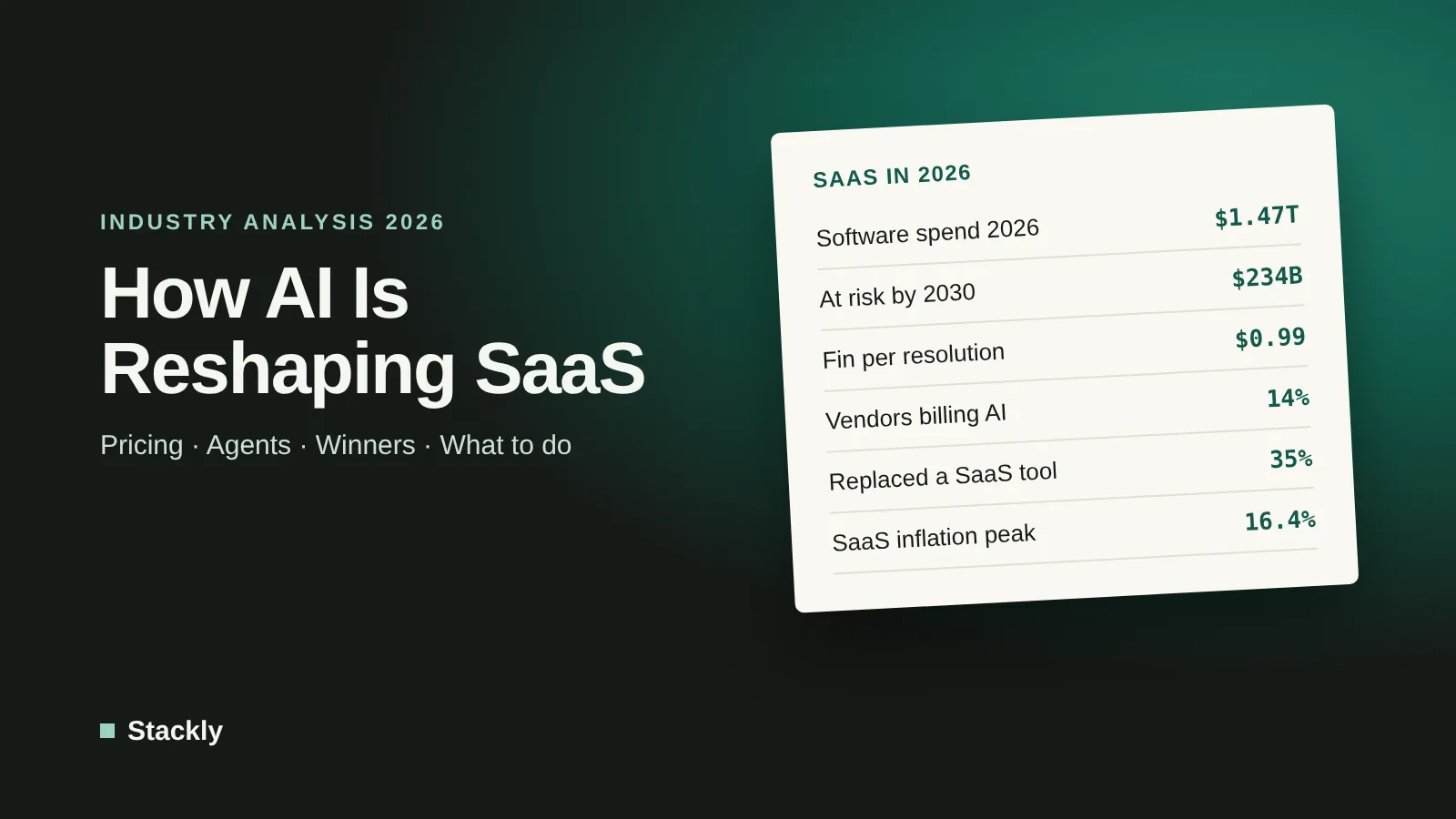
SaaS is not dying; it is changing shape. Gartner expects worldwide software spending to grow 15.5% to $1.468 trillion in 2026, but warns that up to $234 billion of application spending is exposed to AI agents by 2030.
Per-seat pricing is losing ground. More vendors are charging by usage, credits, or outcomes, such as Intercom’s $0.99 per resolved customer conversation.
Your software bills are rising. Vendors are turning free AI features into paid add-ons and raising list prices, and SaaS inflation hit a record in mid-2026.
Businesses are building instead of buying for simpler tools: 35% of respondents in one survey have already replaced at least one SaaS product with a custom build.
AI-native companies are growing at unprecedented speed, while established vendors are cutting jobs, acquiring AI companies, and racing to sell agents.
For small businesses, the opportunity is consolidation: fewer, smarter tools, closer attention to pricing changes, and careful evaluation of AI add-ons.
The SaaSpocalypse: What Happened to Software Stocks in 2026
The year’s defining moment for SaaS came in early February 2026. In the week Anthropic released industry-specific plugins for its Claude Cowork agent, aimed at work such as legal and financial analysis, investors began to question whether AI agents would replace the specialized software and data services those professionals pay for. According to ABC News, Thomson Reuters and LegalZoom each fell more than 15% in a single day, with RELX, FactSet, Salesforce, and Workday also declining.
Bloomberg reported that about $285 billion in market value was erased across software, financial data, and asset management stocks, and Goldman Sachs’ US software basket recorded its biggest one-day drop since the April 2025 tariff selloff. New releases from Anthropic and OpenAI days later added to the pressure, as Fortune reported. Commentators quickly named the episode the “SaaSpocalypse”, and Forbes estimated that roughly $1 trillion of software market value disappeared in the early months of the year.
Then the mood shifted. According to Reuters data reported by American Bazaar, the software index fell more than 26% from late January to its April low, but by early October the S&P 500 software and services index had reached its highest level since November 2025, after its best July-to-September quarter since 2020. Expected 2026 earnings growth for the sector was revised up to 20.6%. Private equity investor Orlando Bravo of Thoma Bravo declared in June that the SaaSpocalypse “is over”.
The lesson: markets overreacted to the idea that AI would simply replace software, but they were right that the industry’s business model is changing. The rest of this guide explains how.
The Numbers: Software Spending Is Still Growing Fast
Despite the panic, businesses are spending more on software, not less. In July 2026, Gartner forecast worldwide IT spending of $6.37 trillion in 2026, up 14.2%, with software spending rising 15.5% to $1.468 trillion. The fastest growth is in AI-related infrastructure, cloud services, and software.
AI spending specifically is exploding. Gartner’s September 2026 forecast puts total AI spending at $2.67 trillion in 2026, up 49.5%, rising to $3.64 trillion in 2027. Within that:
Category
2025
2026
2027
AI software
$288B
$462B
$656B
AI agents and assistants
$16.5B
$29.2B
$65.5B
Crucially, Gartner’s John-David Lovelock notes that much of this adoption happens through the AI features of software businesses already use, rather than entirely new products. That is good news for established vendors that move quickly, and a warning for those that do not.
At the level of individual companies, the shift is even more visible. SaaS management platform Zylo found that spending on AI-native software such as ChatGPT, Claude, and Cursor rose 334% year over year, while spending on traditional SaaS applications with AI features rose 143%.
Why AI Threatens the Classic SaaS Model
Agents Break the Link Between Users and Revenue
Traditional SaaS revenue grows with the number of people who log in. AI agents change that equation. When an agent can read your CRM, update a spreadsheet, and send an email on your behalf, fewer people need their own licenses for each tool.
In July 2026, Gartner put a number on the risk: up to $234 billion of enterprise application spending is exposed to what it calls “agentic arbitrage” between now and 2030, around 20% of enterprise application SaaS spending by 2030. “Agentic AI changes the economics of software,” said Gartner’s George Brocklehurst. “This breaks the link between user growth and revenue growth.” He added that the change is “less an apocalypse and more of a metamorphosis”, and warned that “adding more AI features often creates more cost, not better outcomes” and that “the user interface is no longer a differentiation.”
Earlier Gartner research, quoted in Deloitte’s 2026 technology predictions, predicted that by 2030 at least 40% of enterprise SaaS spending will shift toward usage-, agent-, or outcome-based pricing, and that 35% of point-product SaaS tools will be replaced by AI agents.
Customers Can Build Their Own Tools
AI coding assistants have made it dramatically cheaper to build simple internal software. In Retool’s 2026 Build vs. Buy report, based on 817 respondents:
35% have already replaced at least one SaaS tool with a custom build.
78% expect to build more in 2026.
The categories most at risk are workflow automation (35%), internal admin tools (33%), business intelligence (29%), CRMs and form builders (25%), project management (23%), and customer support tools (21%).
60% have built something outside IT oversight, which raises security and maintenance concerns.
For small businesses, this “vibe coding” trend means a simple booking tool, internal dashboard, or quoting calculator may no longer require a monthly subscription. It does not mean you should rebuild your accounting or payroll system: complex, regulated, or data-heavy software still benefits from specialist vendors.
The Interface Matters Less
When people interact with software through an AI assistant, the beautiful dashboard that once won customers matters less. What matters is the data a product holds, the actions it can perform, and how well it connects to agents through open standards such as MCP. Vendors with valuable proprietary data and strong integrations are better protected than those whose main value was a convenient interface.
From Seats to Outcomes: How SaaS Pricing Is Changing
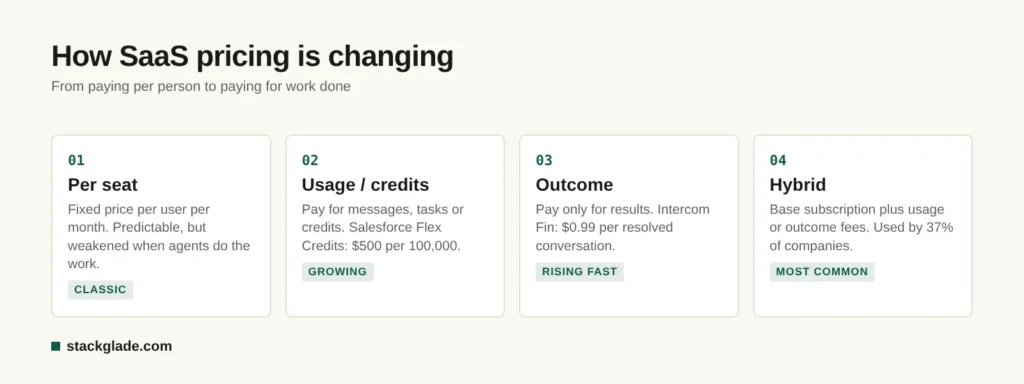
How SaaS pricing is shifting in the AI era.
The biggest visible change for software buyers is pricing. Vendors are experimenting with new models because AI both changes how value is delivered and adds real costs for every task an AI performs.
The New Pricing Models
Per seat: the classic model of a fixed price per user per month. Still common, but increasingly combined with other charges.
Usage or credits: you pay for the volume of AI work, such as messages, tasks, or credits.
Outcome-based: you pay only when the software achieves a result, such as resolving a customer’s question.
Hybrid: a base subscription plus usage or outcome fees, now the most common approach for AI features.
Real Examples
Intercom Fin charges $0.99 per resolution, counted only when a customer confirms their issue was resolved or does not ask for further help.
Zendesk became the first major customer service platform to announce outcome-based pricing for AI agents, charging only for issues resolved autonomously.
Salesforce Agentforce offers several models on its pricing page, including Flex Credits at $500 per 100,000 credits (around $0.10 per action), $2 per conversation, and per-user add-ons of $125 per user per month for some products.
Hybrid pricing used by 37% of companies, up from 25%; 29% use AI credits and another 33% plan to add them; three in four changed pricing in the past year
14% of traditional SaaS vendors billed customers for an AI feature in the past year, up from 8%; usage billing is now 36% of embedded-AI spend
Why Vendors Are Changing Pricing
AI is expensive to run. Every answer, summary, or agent action consumes computing power, unlike traditional software where serving one more user costs almost nothing. ICONIQ found that AI products carry average gross margins of around 45% in 2025, projected to rise to 53% in 2026, far below the 75 to 80% margins classic SaaS companies are used to. Usage and outcome pricing lets vendors pass some of those costs on, and lets customers pay in proportion to value.
What it means for you: budgets become less predictable. A tool that costs a fixed $50 per month today might cost $30 in a quiet month and $150 in a busy one under usage pricing. Zylo’s 2026 SaaS Management Index found that 78% of IT leaders received unexpected charges from consumption-based or AI pricing.
Your Software Bills Are Going Up
Beyond new pricing models, AI is pushing up the cost of the software suites small businesses already rely on:
Microsoft 365 raised commercial prices worldwide from July 1, 2026, citing built-in Copilot Chat and new features, with Business Basic at $7 and Business Standard at $14 per user per month, according to Nasdaq. The full Microsoft 365 Copilot Business add-on costs $21 per user per month.
Google Workspace folded Gemini into its Business plans in January 2025 and raised prices, with Business Standard rising from $12 to $14 per user per month on annual plans, according to 9to5Google.
Paid AI add-ons are spreading. Ramp notes that AI features offered free during beta at companies including Salesforce, Figma, Canva, and GitHub are increasingly becoming paid add-ons.
The overall effect is significant. Spend management platform Vertice reported SaaS inflation reaching a record 16.4% in June 2026 before easing to 14.3%, with SaaS spending per employee around $9,300 to $9,450. Zylo puts the median at $9,455 per employee and found that 36% of software licenses go unused.
The Winners: AI-Native Companies Growing at Record Speed
While incumbents adapt, a new generation of AI-native software companies is growing faster than any SaaS businesses before them:
Cursor, the AI coding editor, reached more than $2 billion in annualized revenue by February 2026, according to Bloomberg, and more than $4 billion by June, according to Dealroom.
Lovable, which lets people build apps by describing them, grew from $100 million in annual recurring revenue in July 2025 to $400 million by February 2026 with only 146 employees, TechCrunch reported.
Replit reached an estimated $525 million in annualized revenue in April 2026, up from $300 million at the end of 2025, according to Sacra estimates.
Benchmark data confirms the gap. High Alpha’s 2025 SaaS benchmarks, covering more than 800 companies, found median growth of 110% for AI-native companies with $1 to $5 million in annual revenue, compared with 40% for traditional B2B SaaS at the same size.
There is a caveat. Bessemer Venture Partners warns that very fast early AI revenue can be fragile, because switching costs are low and customers can move to a competitor or a newer model easily. Some of the fastest-growing AI companies also run much thinner margins than classic SaaS.
How the Incumbents Are Fighting Back
The established SaaS giants are not standing still. Recent earnings show most are still growing, with AI products becoming a meaningful part of the business:
Incumbents are buying AI capabilities and customer relationships. Salesforce signed a definitive agreement in June 2026 to acquire Fin, the company formerly known as Intercom, for about $3.6 billion, and on October 20, 2026, announced a deal to acquire customer engagement platform Braze for about $5.66 billion. Deal activity across SaaS was already high: Software Equity Group counted 2,698 SaaS M&A deals in 2025, up 28%, as cited by SaaSRise.
Job Cuts
AI is also reshaping how software companies operate. TechCrunch’s tracker of 2026 layoffs where employers cited AI includes about 4,000 support roles at Salesforce, around 1,600 jobs (10%) at Atlassian, about 3,000 (17%) at Intuit, and roughly 20% of staff at Monday.com. For customers, this can mean more AI-driven support and fewer human account managers, which is worth considering when choosing vendors.
Who Is Most at Risk, and Who Is Safest?
Not all software is equally exposed to AI disruption:
More at risk:
Simple point solutions that do one task an AI agent or a general assistant can now handle, such as basic note-taking, scheduling, transcription, or simple form tools.
Products whose value is mainly a nice interface over data the customer already owns.
Tools that are easy to rebuild, such as internal dashboards and admin panels, the categories Retool’s survey flagged.
Seat-based tools for roles that agents are automating, such as first-line customer support.
Better protected:
Systems of record that hold critical business data, such as accounting, payroll, ERP, and core CRM.
Regulated and compliance-heavy software, where accuracy, audit trails, and legal responsibility matter.
Products with unique data or network effects that an AI cannot easily reproduce.
Vertical software built deeply around a specific industry’s workflows. Forrester estimates vertical software spending will grow from about $133.5 billion to $194 billion between 2025 and 2029, according to its SaaSpocalypse analysis.
What This Means for Small Businesses Buying Software
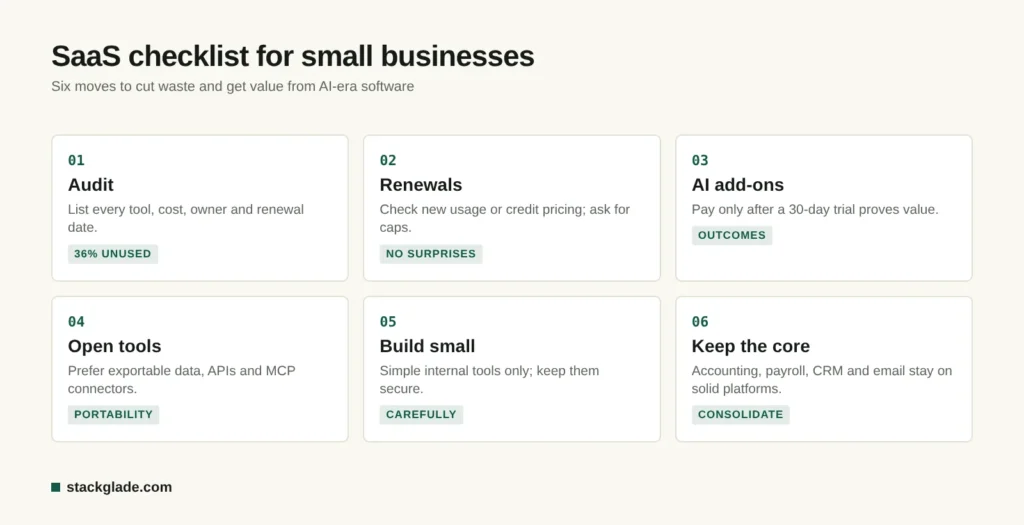
A six-step checklist for managing software in the AI era.
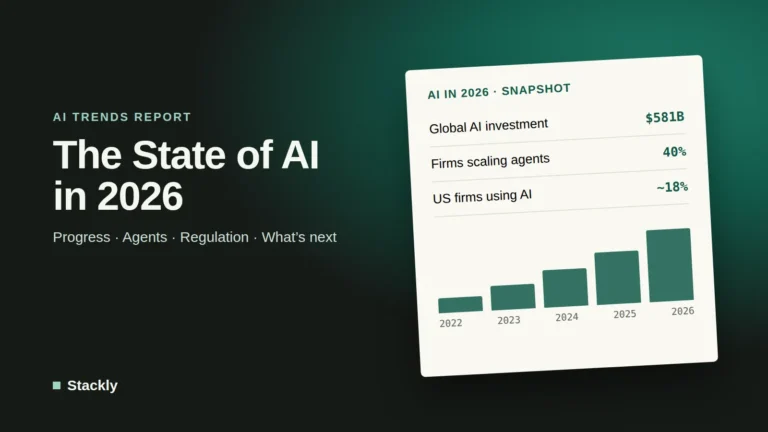
Small businesses are in an unusual position. They are less likely than large companies to use AI so far: the US Census Bureau found 19.8% of US firms used AI as of May 2026, with smaller firms lagging behind, and McKinsey found that only 22% of smaller organizations are scaling AI agents, compared with 40% of large ones. But small businesses also have the most to gain from consolidating tools and paying only for what delivers value.
1. Audit Your Software Stack Now
List every subscription, what it costs, who uses it, and when it renews. With more than a third of licenses unused at the average company, there is almost always money to save. Look especially for tools whose main job is now covered by the AI built into your core suite or general assistant.
2. Read Renewal Notices Carefully
As vendors move to usage, credit, and outcome pricing, renewals may change the way you are billed, not just the price. Ask for estimates based on your actual usage, request caps or alerts on usage-based charges, and avoid committing to large credit bundles before you know how much you will use.
3. Evaluate AI Add-Ons on Outcomes
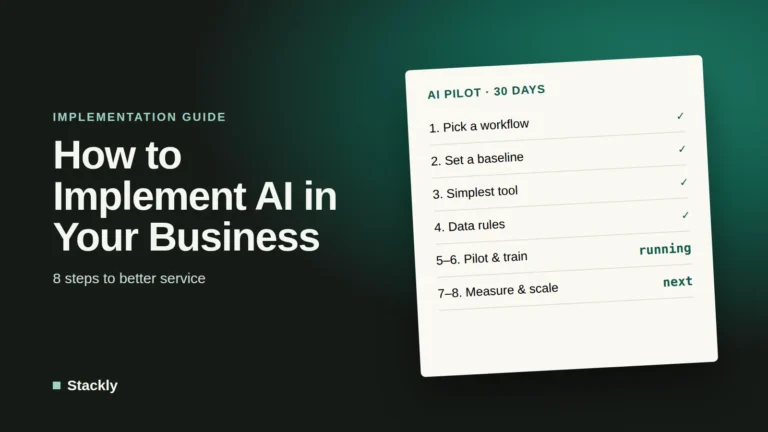
Before paying extra for an AI add-on, run a 30-day trial and measure time saved or results achieved, as described in our guide on how to implement AI in your business. Remember Gartner’s warning that more AI features can mean more cost without better outcomes.
4. Prefer Open, Connected Tools
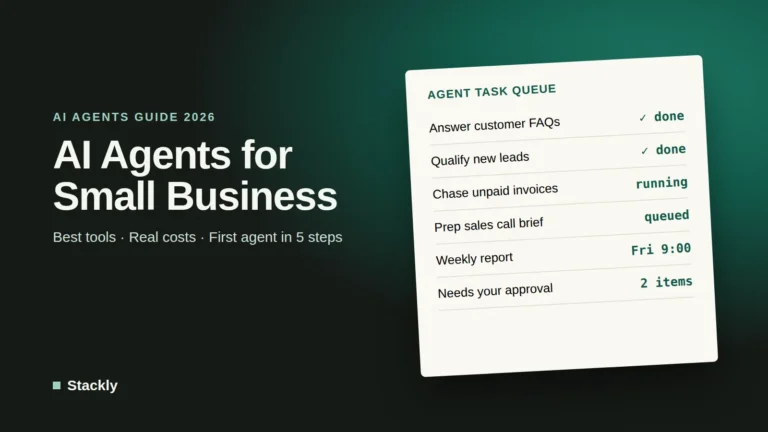
Choose software that exports your data easily and connects to AI assistants and agents through APIs or MCP connectors. This protects you if prices rise or a vendor falls behind. Our guides to AI agents for small business and how to set up AI agents show how connected tools multiply what AI can do.
5. Consider Building Small Tools, Carefully
For simple internal needs, an AI app builder or a general assistant may replace a subscription. But treat anything you build as real software: keep it secure, back up its data, and do not build systems that handle payments, sensitive personal data, or compliance without professional help. The PHP2Shell vulnerability disclosed in October 2026 is a reminder of how quickly security problems can hit any web application.
If you build software, the message from the data is clear: adapt the product and the business model, not just the feature list.
Sell outcomes, not features. Design your product around measurable results and consider pricing tied to them, as Intercom and Zendesk have done.
Plan for AI costs in your margins. Model the cost of every AI action and use hybrid pricing so heavy users pay more.
Become agent-friendly. Offer robust APIs and MCP servers so customers’ agents can use your product; if agents cannot reach you, you risk being bypassed.
Own unique data and workflows. Deep vertical expertise and proprietary data are harder to replicate than an interface.
Watch retention closely. SaaS Capital’s 2026 benchmarks for bootstrapped companies show median net revenue retention of 103% and gross retention of 91%, with median growth slowing to 15%. Low switching costs in the AI era make retention the metric to defend.
Communicate pricing changes transparently. Unexpected charges are a top complaint among buyers, and trust is a competitive advantage.
What Comes Next: SaaS Toward 2030
Looking ahead, most forecasts point to evolution rather than extinction:
AI agents will become a standard part of business software. Gartner has predicted that 40% of enterprise applications will include task-specific AI agents by the end of 2026, up from less than 5% in 2025.
Pricing will keep shifting toward usage, credits, and outcomes, with seat-based pricing surviving mainly as one part of hybrid models.
Consolidation will continue, as large platforms acquire AI-native companies and smaller vendors struggle with AI costs and competition.
Costs will matter more. Gartner expects the inference cost per agentic workflow to rise more than fivefold through 2028 as agents take on longer tasks, which will influence pricing for customers.
Some agentic projects will disappoint. Gartner has predicted that more than 40% of agentic AI projects will be canceled by the end of 2027 because of costs or unclear value.
No, but it is changing it fundamentally. Gartner still expects software spending to grow 15.5% in 2026, and major vendors are growing. However, AI agents are weakening per-seat pricing, enabling customers to build simple tools themselves, and favoring companies with unique data and outcome-based value.
What is the SaaSpocalypse?
SaaSpocalypse is the nickname for the sharp selloff in software stocks in early 2026, triggered partly by new AI agent capabilities from Anthropic and OpenAI. Hundreds of billions of dollars in market value were erased within days, although software stocks had recovered to 2026 highs by October.
How is AI changing SaaS pricing?
Vendors are moving from per-user pricing toward usage-based credits, outcome-based fees, and hybrid models. Examples include Intercom Fin’s $0.99 per resolution and Salesforce Agentforce’s credit and per-conversation pricing. Surveys show outcome- and consumption-based pricing growing quickly among AI companies.
Will AI agents replace SaaS tools?
Some simple point tools will be replaced, especially where an agent or general assistant can do the same job. Gartner has predicted that 35% of point-product SaaS tools could be replaced by AI agents by 2030. Systems of record, regulated software, and products with unique data are much less likely to be replaced.
Why is my software getting more expensive?
Many vendors are adding paid AI features or raising prices to cover AI costs. Microsoft 365 and Google Workspace both raised prices while bundling AI, and spend management data shows record SaaS inflation in 2026. Auditing unused licenses and negotiating renewals can offset much of the increase.
Should a small business build its own software with AI instead of buying SaaS?
For simple internal tools, it can make sense: 35% of respondents in Retool’s 2026 survey have replaced at least one SaaS tool with a custom build. For accounting, payroll, payments, and anything involving sensitive data or compliance, established software remains the safer choice.
The Bottom Line
AI is not ending the software industry, but it is ending software as we knew it. Per-seat subscriptions are giving way to usage and outcome pricing, AI agents are reducing the need for some applications, and AI-native companies are growing faster than any before them, while incumbents respond with agents, acquisitions, and price increases. For small businesses, the smart response is to audit your stack, scrutinize renewals and AI add-ons, favor open and connected tools, and invest in the few core systems that hold your most important data. Those who manage software spending actively will come out of this transition with better tools for less money.
The seat-based SaaS formula breaking because agents can finish work without anyone logging in is the clearest pricing shift I’ve seen described this year. If buyers pay for outcomes instead of seats, vendors that only meter users are going to look expensive fast. One tension I’m watching: AI-native tools that let customers build their own workflows also cannibalize the old “buy another SaaS seat” habit. How are you seeing mid-market buyers renegotiate renewals when an agent covers three apps?
Thanks, great question. We don’t have proprietary deal data, but the pattern in the public numbers is clear. Buyers are using renewals to consolidate: Zylo found 36% of licenses go unused, so the first move is usually cutting idle seats before an agent even enters the conversation. When an agent covers work across several apps, buyers increasingly ask to move part of the contract from seats to usage or outcome pricing, or to bundle the agent into the platform they’re keeping. Vendors are meeting them halfway with hybrid models (Growth Unhinged puts hybrid pricing at 37% of companies, up from 25%), but buyers also push for usage caps and alerts, because 78% of IT leaders report surprise charges from consumption or AI pricing (Zylo). In practice, the app that holds the core data, like the CRM, tends to win the renewal, and the point tools around it lose seats. We’ll keep tracking this as more Q3 results come in.


Leave a Reply