Artificial intelligence has moved faster in the last three years than almost any technology before it. Tools that felt experimental in 2023 are now built into email, spreadsheets, accounting software, and website builders. At the same time, the headlines swing between breathless promises and warnings about bubbles, job losses, and energy use. This guide cuts through the noise. It explains where AI actually stands in 2026, the trends shaping it right now, what experts expect over the next few years, and what all of it means in practice for small businesses and freelancers.
A Short History: How We Got Here
Modern AI did not appear overnight. For decades, researchers built systems that followed hand-written rules or learned narrow tasks, such as recognizing handwriting or recommending products. The big shift came in the 2010s with deep learning, which allowed computers to learn patterns from huge amounts of data, and then in 2017 with the “transformer” architecture that now powers almost every major language model.
The public turning point was the launch of ChatGPT in late 2022. For the first time, anyone could type a question in plain language and get a fluent, useful answer. Competitors such as Claude, Gemini, Copilot, and a growing list of open-weight models followed quickly. Between 2023 and 2025, these systems learned to read images and documents, write and run code, search the web, and remember context across long conversations. By 2026, the focus has shifted again: from chatbots that answer questions to AI “agents” that can carry out multi-step tasks.
Where AI Stands in 2026
The clearest independent snapshot of the field is Stanford University’s annual AI Index report. Its 2026 edition, as summarized by IEEE Spectrum, highlights several striking developments:
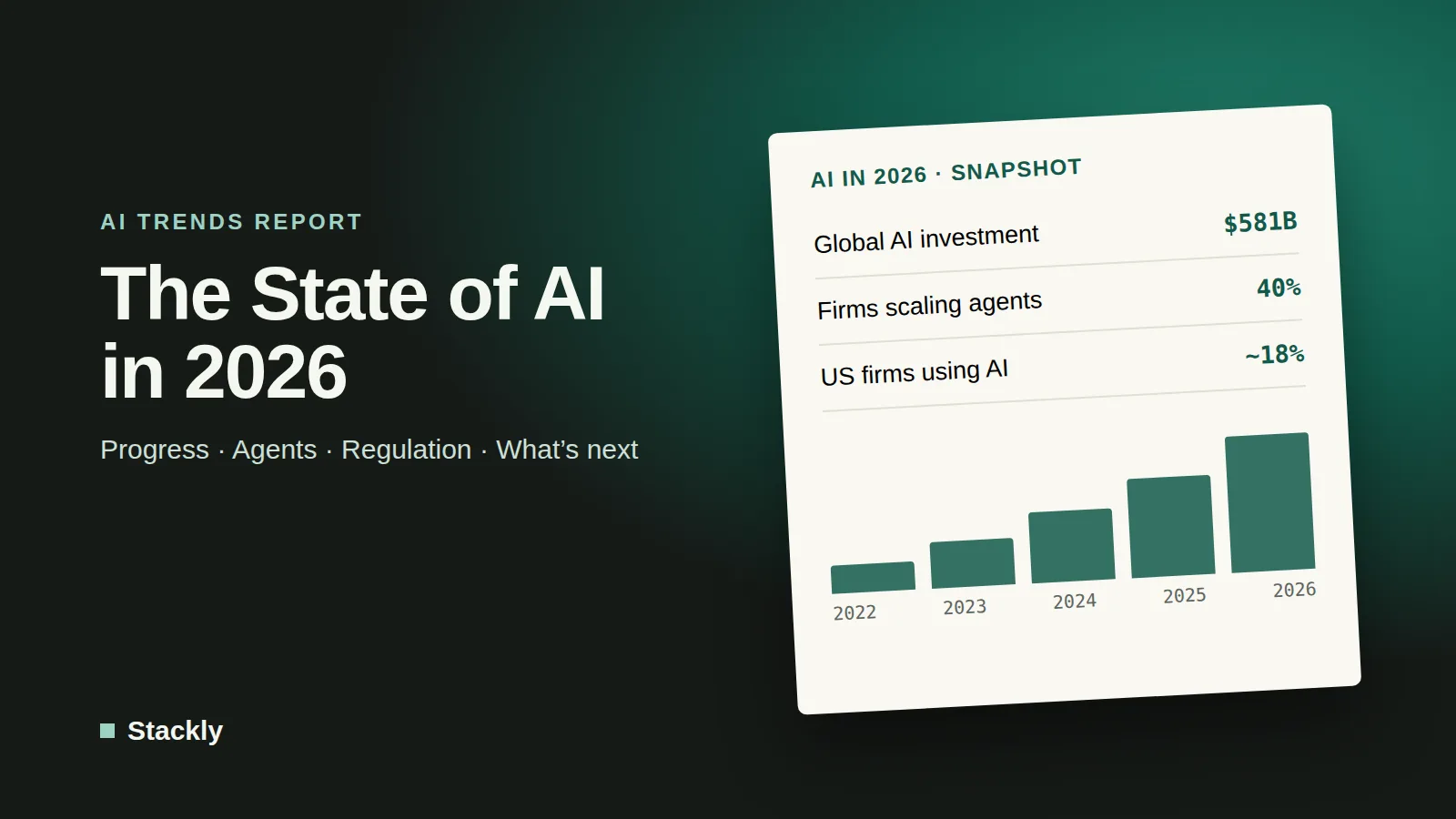
Investment has exploded. Global AI investment reached roughly $581 billion in 2025, more than double the previous year, with the United States accounting for the largest share.
Capabilities keep climbing. On “Humanity’s Last Exam,” a benchmark of extremely difficult expert-level questions, top models went from under 10% accuracy in early 2025 to more than 50% by April 2026.
Industry leads development. Almost all notable new models now come from companies rather than universities, because training frontier systems requires enormous computing budgets.
Public opinion is warming, cautiously. A majority of people surveyed globally now believe AI’s benefits outweigh its drawbacks, but trust in governments to regulate it varies widely by country.
The report also shows that AI remains uneven. Models that can solve advanced math problems can still stumble on simple everyday tasks, such as reading an analog clock. This “jagged” capability is one of the most important things to understand when deciding where to use AI in your business.
How Businesses Are Actually Using AI
Adoption numbers depend heavily on who is asked. McKinsey’s latest State of AI survey, published in August 2026, found that most large organizations now use AI in at least one business function, and around 40% of large enterprises are scaling AI agents, up from 27% a year earlier. Yet only about 37% of respondents attribute any measurable profit impact to AI, and just 6% qualify as “high performers” that see a significant effect on earnings. In other words, using AI is common; getting real business value from it is not.
Small businesses tell a different story. According to the US Census Bureau’s Business Trends and Outlook Survey, only about 17% to 20% of US businesses reported using AI to produce goods or services between December 2025 and May 2026. Use was far higher among firms with 250 or more employees (37%) than among the smallest firms, and adoption among businesses with fewer than 20 employees barely changed during that period. Sector matters too: information and finance businesses use AI at roughly twice the rate of retail.
This gap is both a warning and an opportunity. Large companies are building experience, processes, and data advantages. Small businesses that adopt AI thoughtfully, starting with a few well-chosen tasks, can close much of that gap at a fraction of the cost.
The Biggest AI Trends Right Now
1. From Chatbots to AI Agents
The defining trend of 2026 is the rise of AI agents: systems that can plan and complete a sequence of steps, such as researching suppliers, filling in a spreadsheet, drafting emails, and updating a CRM, with limited human input. Coding agents are the most mature example, and McKinsey found that nearly a third of organizations have chosen to build some software with agentic coding tools instead of buying it.
For most small businesses, AI arrives not as a separate product but as a feature inside tools they already use. Email clients summarize threads, accounting software categorizes transactions, website builders generate page drafts, and CRMs write follow-ups. Gartner expects a third of enterprise software applications to include agentic capabilities by 2028, compared with less than 1% in 2024.
3. Multimodal AI
Leading models now work across text, images, audio, and video. You can photograph a receipt and have it logged, record a meeting and receive action items, or describe an image and generate it. This makes AI useful for far more everyday tasks than text-only tools could handle.
4. Cheaper, Smaller, and Open Models
While the largest models get more expensive to train, the cost of using AI for a given level of performance has fallen sharply. Smaller models and open-weight models that companies can run on their own servers are closing the gap with the leaders, which gives businesses more choice on price and privacy.
5. Energy and Infrastructure Pressure
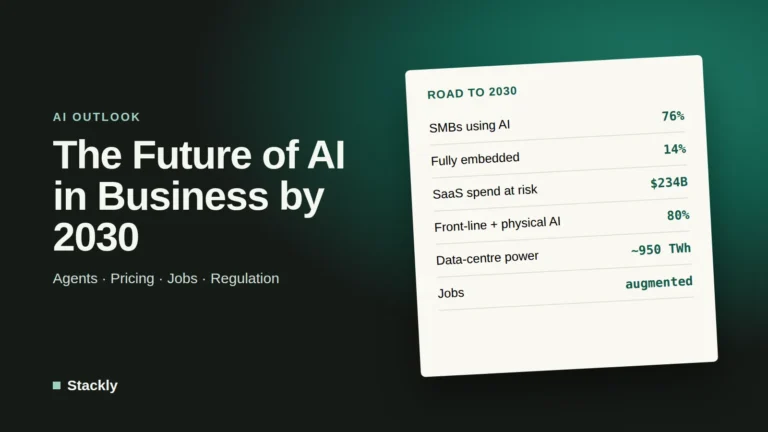
AI’s growth has a physical cost. The International Energy Agency estimates that data centers used about 485 terawatt-hours of electricity in 2025, around 2% of global demand, and projects this could roughly double to about 950 TWh by 2030, with AI-focused data centers growing fastest. Energy supply, chips, and data center construction are now among the main constraints on how fast AI can grow.
6. Regulation Takes Shape
Governments are moving from discussion to rules. The European Union’s AI Act is the most comprehensive framework so far. Under a 2026 package of amendments known as the Digital Omnibus, the strictest obligations for high-risk AI systems were postponed to December 2027 and August 2028, but transparency duties, such as telling people when they are interacting with AI and labeling AI-generated content, are being phased in from 2026. In the United States, regulators such as the Federal Trade Commission continue to apply existing consumer protection law to AI, publishing business guidance that warns against exaggerated or misleading AI claims.
The Future of AI: What Experts Expect
Predicting AI is notoriously difficult, and forecasts should be treated with caution. Still, several expectations are widely shared among researchers, analysts, and industry leaders.
Agents will become more reliable and more common. Expect AI to handle longer, more complex tasks with less supervision, especially in software development, customer service, research, and back-office work. Gartner projects that at least 15% of day-to-day work decisions will be made autonomously by agentic AI by 2028.
AI will become invisible infrastructure. Much like cloud computing, AI will increasingly sit behind the scenes of the apps you already use, rather than being something you open separately.
Work will change more than it disappears, at least in the near term. McKinsey found that far fewer organizations actually reduced headcount because of AI than had expected to, but a growing share anticipate changes ahead. The most likely outcome for most roles is a shift in tasks: less routine drafting, data entry, and searching, and more reviewing, deciding, and dealing with people.
Costs and energy will shape the pace. Cheaper models make AI more accessible, but the computing and electricity needed for the most advanced systems will keep rising, influencing prices and where AI is deployed.
Rules and trust will matter more. As regulation matures and customers become more aware of AI, businesses will need to be transparent about how they use it and accountable for what it produces.
Some predictions go much further, including claims that AI will match human experts across most tasks within a few years. There is no consensus on these timelines, and it is wise to plan around what today’s tools can reliably do rather than what they might do someday.
Risks and Limitations to Keep in Mind
AI’s progress does not remove its weaknesses. Language models can still produce confident but wrong answers, so important facts, figures, and legal or financial details always need human checking. AI tools can reflect biases in their training data. Sharing customer information with AI services raises privacy and data protection questions, especially under laws such as GDPR. And AI has become a tool for attackers too, making phishing emails and scams more convincing, which is one more reason to follow a solid website security checklist.
There is also a financial risk: paying for tools that do not deliver. The gap between AI adoption and real profit impact in the McKinsey data shows how easy it is to spend on AI without changing how work actually gets done.
What This Means for Small Businesses
You do not need a big budget or a data science team to benefit from AI in 2026. The businesses getting real value tend to follow a few simple principles:
Start with a specific problem. Pick a repetitive task that eats time every week, such as answering common customer questions, writing first drafts, or processing invoices.
Use the AI already in your tools. Check what your email, accounting, CRM, and website platforms already include before buying something new.
Keep a human in the loop. Treat AI output as a draft, and review anything that goes to customers or involves money.
Measure the result. Track time saved or revenue gained, and drop tools that do not pay for themselves.
Protect your data. Read privacy terms, avoid pasting sensitive client information into tools that may use it for training, and secure the accounts connected to AI services.
AI is more capable, cheaper to use, and more widely available than ever. Leading models can reason through complex problems, work with text, images, and audio, and increasingly complete multi-step tasks as agents. However, business results are uneven: many organizations use AI, but only a minority report significant profit impact.
What are the biggest AI trends right now?
The main trends are the shift from chatbots to AI agents, AI features built directly into everyday software, multimodal models, cheaper and open models, growing pressure on energy and infrastructure, and the arrival of formal regulation such as the EU AI Act.
Will AI replace jobs?
AI is more likely to change jobs than eliminate them in the near term, by automating routine tasks and shifting people toward review, judgment, and relationship work. Surveys show fewer job cuts from AI so far than companies expected, though many anticipate more changes ahead.
Is AI worth it for a small business?
Often yes, if you start with a clear problem and measure results. Many useful AI features are included in software you already pay for, and free or low-cost tools can save hours each week on writing, customer service, and admin tasks.
What is an AI agent?
An AI agent is a system that can plan and carry out a series of steps toward a goal, such as gathering information, filling in forms, and updating other apps, rather than simply answering a single question. Agents can save significant time but still need clear limits and human oversight.
The Bottom Line
AI in 2026 is neither a passing fad nor a magic solution. It is a fast-maturing technology that is becoming part of the everyday tools businesses rely on. The biggest winners so far are not those who adopt the most AI, but those who use it deliberately: choosing clear problems, keeping people in charge of important decisions, and measuring real results. For small businesses, the best time to build that habit is now, one practical task at a time.
Leave a Reply